
Hospital Renovation Without Disruption: A Strategic Guide for Indian Healthcare Leaders
The Hidden Crisis in Hospital Expansion Projects
Hospital renovations in India fail more often than they succeed—not because of poor construction, but because operations are treated as an afterthought. A 200-bed facility in Mumbai recently saw revenue drop 30% during a six-month OT renovation. Another hospital in Bangalore faced a HAI outbreak linked to construction dust, delaying NABH accreditation by 18 months. These aren’t isolated incidents—they’re predictable outcomes of prioritizing construction timelines over operational continuity.
The uncomfortable truth: hospital expansion is not a construction problem; it’s an operations continuity problem with a construction component. Understanding this distinction determines whether your renovation strengthens your hospital or accidentally shuts it down.
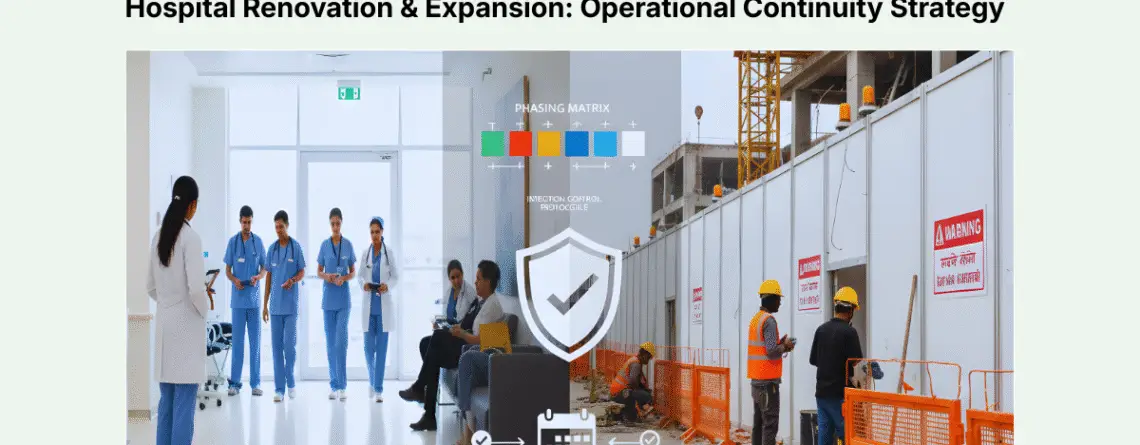
The Phasing Matrix: Strategic Sequencing for Renovation Success
The most damaging mistake hospitals make is renovating the wrong area first. Intuition says “tackle our biggest problem”—but this is often exactly wrong. Strategic sequencing requires evaluating every component on two dimensions:
Understanding Your Renovation Quadrants
Axis 1: Revenue/Criticality Impact if Disrupted
- High Impact: Main OTs, ICUs, Emergency, Labour Rooms—disruption immediately affects income and patient safety
- Low Impact: Administration, medical records, staff facilities—temporary disruption is inconvenient but not catastrophic
Axis 2: Ease of Phasing/Decanting
- Easy to Phase: New standalone structures, back-office areas—minimal service relocation
- Hard to Phase: Existing wards, OTs with equipment, ICUs with ventilated patients—complex temporary relocations
This creates four strategic quadrants with distinct approaches:
Quadrant 1 – Critical Core (High Impact / Hard to Phase): Your main OTs, ICUs, Emergency Department. Strategy: Renovate LAST. Protect at all costs during early phases. Only touch after creating permanent replacement capacity elsewhere.
Quadrant 2 – Strategic Priorities (High Impact / Easy to Phase): High-volume OPD clinics, dialysis units, day-care procedure rooms. Strategy: Mid-project execution using swing spaces created in earlier phases. Execute in controlled, sequential micro-phases.
Quadrant 3 – Foundational Enablers (Low Impact / Hard to Phase): CSSD, electrical substations, HVAC plants. Strategy: Early to mid-project. Set up parallel systems before disrupting services.
Quadrant 4 – Golden Start (Low Impact / Easy to Phase): Administration block, HR offices, medical records, staff cafeteria. Strategy: START HERE. Creates momentum and generates “decanting space” for later phases.
The Winning Sequence: 4 → 3 → 2 → 1
A 300-bed hospital proved this approach. They built a new admin block first (6 months), converted the old admin building into temporary “swing OT” with two modular theatres (4 months), then built a new 6-OT complex while operating with 2 original + 2 swing OTs—zero capacity loss (8 months). Finally, they renovated the old OT space into an expanded ICU (2 months). Total project: 20 months with +8% revenue growth maintained throughout.
The competitor who tried renovating OTs “one at a time” saw constant disruption, infection control failures, project stretched from 6 to 18 months, and 30% revenue decline.
The Operational Playbook: Six Non-Negotiable Systems
Strategic sequencing means nothing without tactical execution. Your playbook must address six critical systems:
1. Communication War Room
Silence creates rumors. Rumors destroy trust. Lost trust equals lost patients and revenue.
Patient communication: SMS/WhatsApp pre-arrival notifications with updated maps. Trained volunteers at decision points. Digital boards showing project progress and service continuity.
Staff retention: Weekly 15-minute departmental briefings. Daily-updated project intranet. Designated liaison available 8 AM-6 PM.
Doctor management: Personal outreach to top revenue-generating consultants before disruptive phases. Proactive problem-solving: “Dr. Sharma, we’ve arranged a temporary premium consultation room. Can we show you the setup?”
2. Temporary Service Setups (No Compromise on Quality)
“Temporary” cannot mean “substandard.” If clinicians don’t trust your temporary setups, they’ll reduce volume or move cases elsewhere.
Requirements include detailed floor plans with equipment lists, workflow mapping bypassing construction zones, dedicated infection control measures, and zero-downtime transition protocols. Weekend transition model: Friday evening final cases, overnight equipment move and setup, Saturday orientation and mock procedures, Monday first live cases.
Service-level commitments: OT—zero reduction in available theatre hours. ICU—100% bed availability maintained. Emergency—zero compromise, period.
3. ICRA-Compliant Dust & Infection Control
Construction dust carries Aspergillus spores and bacteria that cause HAIs. One outbreak can shut down your project and destroy your reputation.
Physical barriers: Floor-to-ceiling hard partitions (not plastic sheets). Double-barrier system with 3-foot “dirty corridor.” Sealed anterooms with sticky mats at penetration points.
Air pressure management: Negative pressure in construction zones (-0.02 to -0.05 inches water column). HEPA filtration on all exhaust. Positive pressure maintained in adjacent patient areas.
Monitoring authority: Designated Infection Control Nurse conducts daily audits (7 AM and 3 PM). Has unilateral authority to stop work if protocols violated—no appeals to contractor.
4. Noise & Vibration Management
Noise delays patient recovery and damages staff morale. Vibration can destroy sensitive equipment costing lakhs in repairs. Patients who can’t sleep due to jackhammering leave 1-star reviews and never return.
Time-based zoning: Map your hospital’s rhythm. Restrict jackhammering during 9 AM-12 PM (OPD peak), 2 PM-4 PM (patient rest), 10 PM-6 AM (critical sleep window).
Equipment protection: No high-vibration work within 50 meters of MRI suites, cath labs, lab analysers, or OT microscopes during operational hours. Install seismograph sensors with real-time monitoring and automatic work stoppage.
5. Safety & Security Protocols
A running hospital is not a construction site. One serious incident—a patient wandering into construction, a fire, a security breach—can shut down your entire project.
Segregated circulation: Construction workers never share pathways with patients or staff. Dedicated routes, color-coded identification, escort requirements for any hospital-area access.
Fire & life safety: No fire exits ever blocked. Construction zones integrated into hospital fire alarm system. Modified evacuation drills during each phase. Daily hot work permits with fire watch.
6. Weekly Leadership War Room
Problems detected late become crises. Weekly cross-functional meetings—run with military discipline—catch issues while manageable.
Fixed 60-minute agenda: Minutes 0-10: Safety and infection control (go/no-go for next week’s work). Minutes 10-20: Patient and staff impact metrics. Minutes 20-35: Project progress vs. schedule. Minutes 35-45: Financial and commercial status. Minutes 45-55: Forward look and decision points. Minutes 55-60: Action items and close.
Decision authority: Infection Control Officer, safety officer, or medical director can halt work unilaterally if patient safety at risk. Work stays stopped until resolution—no appeals.
Why Hospitals Fail (And How to Succeed)
Hospitals don’t fail during expansion because they grow too fast. They fail because they underestimate how fragile operations become during change.
Failed approach: Treat renovation as a construction project. Focus on timelines and budgets. Assume operations will “work around” construction. React to problems as they arise.
Successful approach: Treat renovation as a business continuity program. Embed operational continuity into every decision. Plan the “hospital within a hospital.” Execute with military discipline and transparent communication.
The hospitals that succeed protect three things simultaneously: revenue streams (through strategic phasing and temporary capacity), patient safety (through infection control and service continuity), and staff trust (through communication and support).
Key Takeaways for Hospital Leaders
- Sequence strategically: Start with low-impact spaces that create “decanting capacity” for later phases. Save critical areas (OT, ICU, Emergency) for last.
- Invest in barriers: ICRA-compliant dust and infection control isn’t optional—it’s the line between success and outbreak-driven shutdown.
- Maintain capacity: Temporary facilities must match permanent quality. If clinicians don’t trust them, they’ll divert cases elsewhere.
- Communicate relentlessly: Weekly briefings for staff, pre-arrival notifications for patients, personal outreach to key doctors. Silence creates rumors that destroy trust.
- Empower infection control: Give your IC officer unilateral work-stoppage authority. One HAI outbreak costs more than any construction delay.
- Meet weekly: Cross-functional “war room” meetings catch problems early. Problems detected late become crises.
Conclusion: The Hospital as Living Organism
Your hospital is not just a building—it’s a living ecosystem of patients, staff, trust, and revenue streams that must continue functioning seamlessly even as you rebuild around it.
Plan the hospital within the hospital. Execute with discipline. Communicate with transparency. Do this, and growth will follow safely. Skip this, and your expansion may become your greatest operational crisis.
The choice isn’t between renovation and risk—it’s between strategic renovation that strengthens your institution and haphazard construction that accidentally shuts it down.


Leave a Reply