
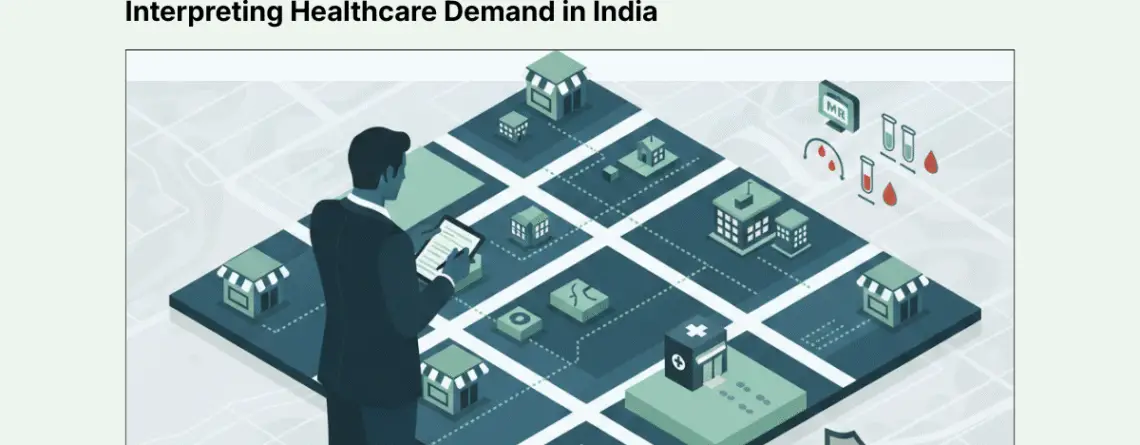
Reading Your Catchment Area: A Doctor-Investor’s Guide to Interpreting Healthcare Demand in India
To accurately assess healthcare demand in your catchment area, go beyond population numbers. Observe five unconventional signals: pharmacy density and medication sales patterns, school van routes indicating family concentrations, traffic at existing clinics, local insurance penetration, and diagnostic center activity. Then validate through GP referral patterns, pharmaceutical sales data, and professional market research that includes household surveys and gap analysis. Cross-check all findings with ground reality before making investment decisions.
Introduction: Why Census Data Isn’t Enough
Most first-time hospital promoters ask the same question: “How many people live in my catchment area?”
Population matters, but it doesn’t tell the whole story. Two cities with identical populations can have completely different healthcare utilization patterns, disease burdens, and hospital profitability. Real demand hides in daily behaviors, not just census tables.
A successful doctor-investor doesn’t just count the catchment—they read it. They observe movement, transactions, illnesses, and choices, then connect the dots.
This guide teaches you that skill through three strategic lenses: unconventional demand signals, specialty-wise estimation, and professional market research interpretation.
Part 1: Five Unconventional Signals That Reveal Healthcare Demand
Before commissioning expensive feasibility studies, become an observer. These ground-level indicators offer immediate insights into your catchment’s health-seeking behavior.
1. Pharmacy Density and Purchase Patterns
A cluster of retail pharmacies within a single neighborhood signals chronic disease load—diabetes, hypertension, thyroid conditions—and strong outpatient activity nearby.
Don’t just count pharmacies. Talk to owners and observe:
- Which medications move fastest—chronic disease drugs or acute care antibiotics?
- Are painkillers and antacids flying off shelves, indicating lifestyle illnesses?
- When are they busiest? Early morning and late evening peaks often correlate with working-class OPD patterns.
High over-the-counter sales reveal self-medication culture and unmet primary care demand that your facility could capture.
2. School Van Routes and Family Density
School concentrations indicate young families, which correlate with pediatric loads, maternity potential, vaccination demand, and adolescent care needs. Dense school clusters often predict long-term pediatric and maternity service requirements.
Observe where school vans converge during drop-off and pick-up times. These routes map your primary catchment for family medicine services.
3. Traffic Patterns at Existing Clinics
Stand outside a well-known GP or specialist clinic for one hour. Count vehicles arriving, referrals being written, and repeat patients returning. Notice whether registrations are local or from distant areas.
That single hour often reveals more truth than a 70-page consultant report. High out-of-station traffic suggests a regional vacuum that a new, well-positioned facility could fill.
4. Insurance Penetration and TPA Activity
Areas with growing insurance adoption tend to shift faster toward private hospital utilization because paying capacity increases. Check with local corporate offices, gated community associations, and TPA representatives:
- Which policies sell most frequently?
- What is the average coverage amount?
- How often are cashless claims being processed?
High insurance penetration correlates with lower price sensitivity and preference for quality tertiary care.
5. Diagnostic Center Activity and Backlogs
Labs and diagnostic centers function as demand thermometers. High volumes of specific tests point clearly toward specialty-based opportunities:
- TMT and echocardiography suggest cardiology demand
- MRI for knees and spine indicates orthopedic needs
- HbA1c and lipid profiles reveal diabetes and cardiology potential
- Long wait times for advanced imaging signal unmet demand for neurology and oncology diagnostics
These behavioral signals aren’t “soft” data—they’re real-world patterns that quietly shape actual revenue.
Part 2: Estimating Specialty-Wise Demand
Observations form hypotheses; methodology validates them. To estimate whether your catchment can support cardiology, orthopedics, gastroenterology, or oncology, go one layer deeper.
Study GP Referral Behavior
General practitioners control most patient movement. Ask them:
- Where do you refer cardiac cases, fractures, or complex diabetes patients?
- Which hospitals take your trauma referrals?
- Do patients complete referrals or drop out due to distance or cost?
These patterns reveal not just volume but trust networks. If GPs are referring out more than 10 cardiac cases monthly due to lack of local cath labs, you’ve identified a gold-mine specialty.
Analyze Diagnostic Trends
Partner with local diagnostic centers to understand test volumes. Rising trends in specific diagnostics predict specialty demand:
- Cardiac stress tests and echoes indicate cardiology opportunity
- Bone density and vitamin D tests suggest orthopedic and geriatric potential
- Thyroid panels and HbA1c reveal endocrinology needs
Review Pharmaceutical Sales Patterns
Medical representatives understand markets before planners do. Ask which specialties drive most prescriptions and whether lifestyle drugs are growing. When cardiology prescriptions rise while orthopedic prescriptions remain steady, the market is signaling its needs.
The Structured Estimation Framework
- Identify proxies for each specialty (cardiology equals echo volumes plus anti-hypertensive sales plus GP referrals for chest pain)
- Gather data points from field research
- Apply conservative penetration rates (if 10,000 estimated hypertension cases exist and 5% annually need specialist care, that’s 500 potential cardiology patients)
- Calculate realistic capture rates (20% in year one is reasonable)
- Translate patient estimates to required bed capacity
This converts scattered observations into actual projections instead of gut feeling.
Part 3: Commissioning Professional Market Research
When stakes are high, structured research makes sense. But many promoters pay for impressive reports that prove useless in boardrooms. The key is knowing what to ask before the survey begins.
What to Demand in Household Surveys
Ensure the study explores:
- How people choose hospitals—doctor reputation, brand, cost, or distance?
- Willingness to travel for different types of care
- Average spending for planned versus emergency admissions
- Awareness of insurance and cashless availability
- Experience with government versus private hospitals
Real decisions happen inside those questions.
Interpreting Gap Analysis Properly
Gap analysis shouldn’t just state “your city needs 120 more beds.” It should explain:
- Which specialties are genuinely underserved
- Price bands where new hospitals can compete successfully
- Patient segments currently ignored by existing providers
- Time horizons for demand maturation
Otherwise, it’s just arithmetic without strategy.
Validating Research with Ground Reality
Never rely on reports alone. Cross-check findings with local doctors, pharmacists, municipal health offices, and diagnostic center owners. If the data and street-level truth disagree, chase the truth—not the PowerPoint.
A quality report should translate demand into average revenue per occupied bed. If research shows high density of economically weaker populations, your financial model must pivot toward high-volume government schemes like Ayushman Bharat. If the gap is in premium maternity services, your strategy shifts toward hospitality and aesthetics.
The Doctor-Investor Mindset: Thinking Like a Clinician, Deciding Like a Strategist
Hospitals are capital-heavy, slow-maturing, reputation-driven businesses. Anyone can build walls and install beds. The winners are those who listen carefully to communities, match services to real needs, build gradually instead of chasing grandeur, and validate assumptions before signing checks.
Reading your catchment is part science, part anthropology, part curiosity. Walk it. Sit in it. Talk within it. Healthcare demand is always visible once you learn where to look.
Frequently Asked Questions
What exactly is a catchment area in healthcare?
A catchment area is the geographic region from which your hospital will realistically draw patients, based on travel habits, affordability, and referral networks. In Tier-2 cities, this typically spans 5-8 kilometers for general care, expanding for basic services and shrinking for super-specialties.
Is population data still important for hospital planning?
Yes, but only as context. Utilization behavior, disease burden, and paying capacity matter more than raw headcount. A smaller, affluent population with high insurance penetration often generates more sustainable revenue than a larger population with limited paying capacity.
Should I rely only on consultants for feasibility studies?
Use consultants but verify their findings with ground observation and local physician insights. Professional reports provide structure, but street-level truth reveals whether the data reflects reality.
Can informal signals like pharmacies really guide strategy?
They’re often more predictive than spreadsheets because they reveal behavior, not just numbers. Pharmacy sales, school routes, and clinic traffic patterns reflect actual health-seeking choices that directly impact hospital utilization.
How do I estimate demand for specific specialties?
Combine multiple data sources: GP referral patterns, diagnostic test volumes, pharmaceutical sales trends, and competitor discharge patterns. Use conservative capture rates and translate estimates into bed-day requirements for financial modeling.
Conclusion: Data is Your New Stethoscope
Every hospital project begins with a dream, but the ones that survive are anchored in reality. Learn to observe your city like a physician taking a patient history. Diagnose the catchment with curiosity, skepticism, and humility.
That’s how doctor-investors avoid expensive mistakes and build hospitals communities truly need.
Healthcare demand in India is a narrative woven from local habits, trusted networks, and economic reality. By reading unconventional signals, applying structured estimation, and validating professional research with ground truth, you move from hoping patients will come to knowing they will.
Your hospital’s services should reflect both articulated and unarticulated community needs. Start listening before you start building.





Comment (1)
I am a mba healthcare management and i like promot health industry and improve healthcare services.