
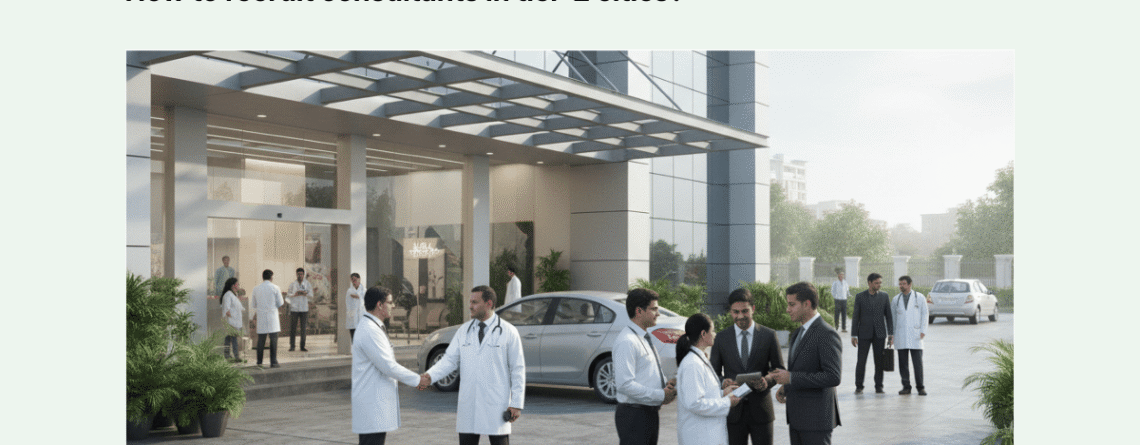
How to recruit consultants in tier-2 cities?
What is the best way to recruit doctors in tier-2 cities?
The best way to recruit doctors in tier-2 cities is to offer a compelling value proposition beyond just salary—combining competitive compensation with professional growth opportunities, modern infrastructure, work-life balance, and family support. Successful doctor recruitment India strategies focus on building personal relationships through direct outreach to medical colleges, offering flexible revenue-sharing models, and addressing the complete relocation needs of doctors and their families. Start recruitment 6-9 months before hospital launch, leverage alumni networks, and emphasize lifestyle advantages of tier-2 cities like lower living costs, reduced commute times, and community integration that metro cities cannot provide.
15 proven strategies to attract doctors to new hospitals
- Tap medical college alumni networks – Doctors often prefer returning to cities where they studied; contact medical colleges in your region and neighboring states to reach alumni.
- Offer revenue-sharing partnerships – Provide consultants equity or profit-sharing arrangements that align their success with hospital growth, creating ownership mentality
- Guarantee modern infrastructure – Showcase advanced equipment, digital systems, and well-equipped operation theaters that match or exceed metro hospital standards
- Provide housing assistance – Offer furnished accommodation for the first 6-12 months or housing allowances to ease relocation burden
- Support spouse employment – Actively assist in finding positions for doctors’ spouses through local corporate networks or within hospital administration
- Emphasize work-life balance – Highlight predictable schedules, manageable patient loads, and quality family time unavailable in high-pressure metro hospitals
- Create academic opportunities – Establish teaching programs, research facilities, and CME platforms for doctors seeking academic engagement alongside clinical practice
- Leverage government incentives – Utilize state-specific incentives for healthcare professionals in underserved areas to supplement compensation packages
- Build personal relationships – Hospital promoters should personally visit and build rapport with target consultants rather than relying solely on HR recruitment
- Showcase quality of life – Emphasize lower pollution, affordable lifestyle, proximity to nature, and strong community connections tier-2 cities offer
- Offer flexible working models – Allow part-time arrangements, visiting consultant options, or phased transition for doctors hesitant to immediately relocate
- Provide comprehensive relocation support – Handle school admissions for children, documentation, local area orientation, and settling-in logistics
- Create multi-specialty teams – Recruit in groups so specialists have peer support and collaborative practice environment rather than working in isolation
- Guarantee patient volume – Provide minimum income guarantees initially while the hospital builds patient base, reducing financial uncertainty
- Establish clear growth pathways – Define progression to department head, medical director, or equity partner roles based on performance and tenure
Compensation models
Fixed salary model provides predictable monthly income ranging from ₹1.5-4 lakhs for specialists in tier-2 cities, with annual increments of 10-15%. This model suits early-career doctors seeking stability and hospitals wanting cost predictability. Include performance bonuses of 15-20% based on patient satisfaction scores, department revenue, and clinical quality metrics. Add retention bonuses payable after completing 2-3 years to reduce staff attrition.
Revenue sharing model typically offers 30-40% of consultation fees and 15-25% of procedure revenues to consultants. This aligns doctor incentives with hospital growth and rewards high performers. Structure it as base salary (₹50,000-1 lakh) plus percentage of revenue generated above a threshold. Clearly define what counts as “revenue”—only consultation fees, or including diagnostics and pharmacy revenues from their patients.
Hybrid model combines modest fixed component (₹75,000-1.5 lakhs) with revenue participation (20-30% of collections above target). This balances income security with performance incentives. Popular in new hospitals where patient volumes are initially uncertain but expected to grow. Transition to pure revenue-sharing as hospital matures and patient flow stabilizes.
Retainer plus per-service model suits visiting consultants or those working part-time. Pay monthly retainer (₹30,000-75,000) for guaranteed availability certain days/hours, plus per-consultation or per-procedure fees. Common for super-specialists in early stages before full-time recruitment justifies.
Equity partnership model offers consultants 2-10% equity stake in the hospital, with buy-in at discounted valuations or through sweat equity arrangements. This creates long-term commitment and shared vision. Structure vesting over 3-5 years to ensure retention. Particularly attractive to senior consultants looking for entrepreneurial opportunities beyond employment.
Non-monetary incentives
Professional development support including fully-funded attendance at national/international conferences (2-3 annually), subscriptions to medical journals, and access to online learning platforms. Sponsor fellowship training or certification courses in specialized techniques, enhancing both doctor’s skills and hospital’s service offerings.
Academic affiliations by partnering with medical colleges for teaching assignments or research collaborations. Many doctors value professor/associate professor titles and academic engagement. Establish in-house journal clubs, case presentation forums, and research support infrastructure.
Advanced infrastructure access to cutting-edge equipment often unavailable in tier-2 cities—robotic surgery systems, advanced imaging, specialized laboratory facilities. Autonomy in clinical decision-making without bureaucratic interference common in large corporate hospitals.
Lifestyle benefits such as club memberships, vehicle allowances or car leasing, health insurance covering entire family, children’s education allowances for premium schools, and generous leave policies (30-45 days annually versus 15-20 days in metro hospitals).
Administrative support through dedicated paramedical staff, medical assistants handling documentation, and appointment scheduling managed by hospital systems. Free doctors from non-clinical burdens to focus on patient care and maintain better work-life balance.
Infrastructure support
Provide fully-equipped consultation chambers with modern furniture, examination equipment, computers with EMR access, and personalized branding. Allow doctors to customize their spaces within hospital aesthetics guidelines.
Ensure state-of-the-art diagnostic facilities including in-house pathology, radiology, and specialized labs so doctors aren’t handicapped by referrals to external facilities. Availability of advanced imaging (MRI, CT, interventional radiology) critical for specialist recruitment.
Offer dedicated operation theater access with scheduled blocks for surgeons, modern anesthesia equipment, and trained OT staff. Guarantee instrument availability and support staff quality matching metro standards.
Establish 24/7 emergency backup systems—generators, oxygen supply, blood bank access—so doctors never compromise patient care due to infrastructure failures. Robust IT systems with reliable internet connectivity for telemedicine and research.
Create comfortable doctor lounges with rest areas, pantry facilities, and private spaces for case discussions. Recognize that environment quality impacts both recruitment and daily job satisfaction.




Leave a Reply